Solar Energy
 What is Solar Energy?
Solar energy is a renewable source of power generated from sunlight. Even in the circumpolar North, where long periods of darkness occur in winter, solar energy can still be a viable energy source due to extended daylight hours during spring and summer.
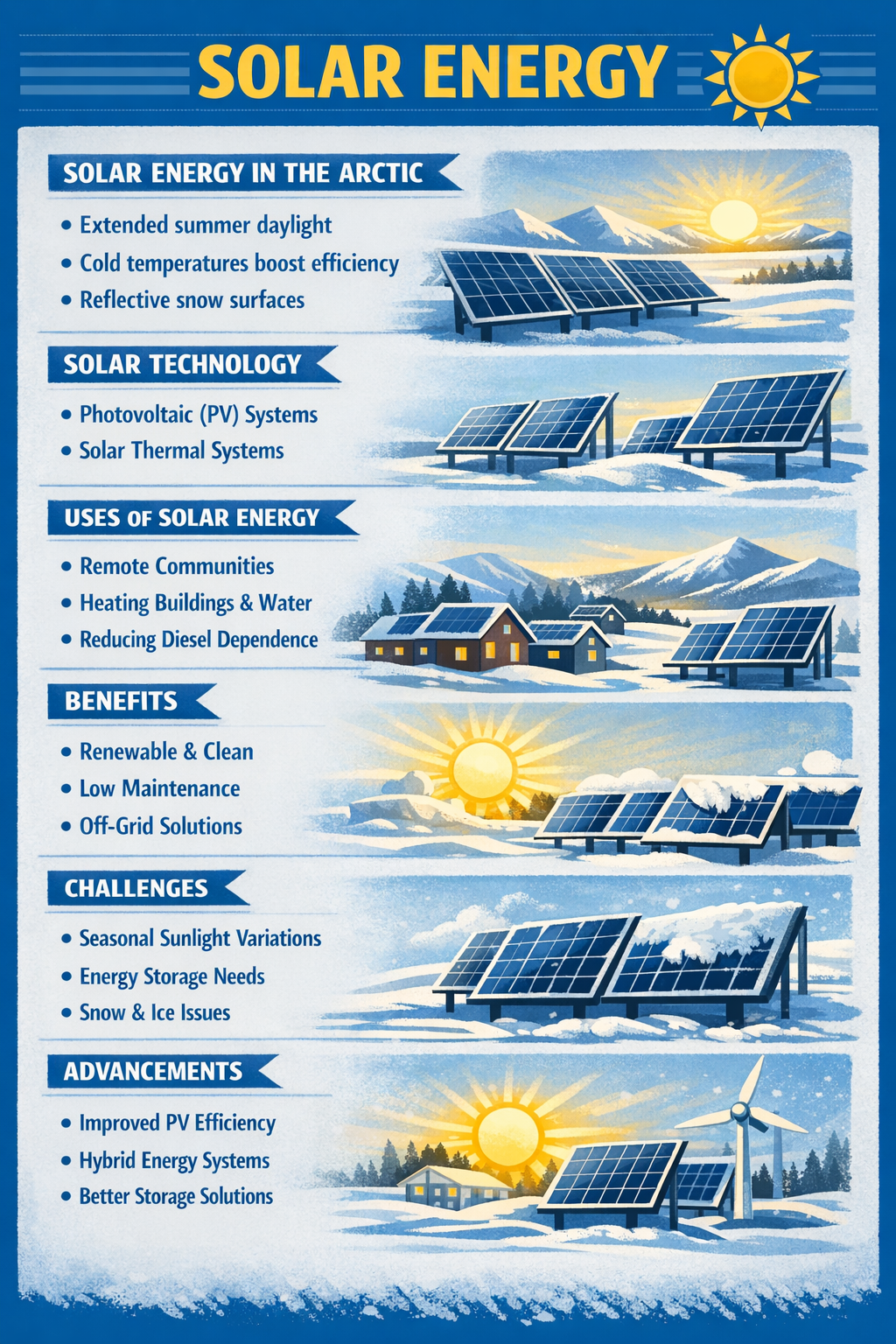
Solar Energy in the Arctic
Although the Arctic experiences extreme seasonal variation in sunlight, it also benefits from:
- Continuous daylight during summer months (midnight sun)
- Cold temperatures, which can improve the efficiency of solar panels
- Reflective snow surfaces that can increase light availability
These factors make solar energy a useful supplementary energy source in high-latitude regions.
Types of Solar Technology
Solar energy in the Arctic is mainly harnessed through:
- Photovoltaic (PV) systems, which convert sunlight directly into electricity
- Solar thermal systems, used for heating water or buildings (though less common in Arctic conditions)
Photovoltaic technology remains the most widely used and practical option in northern regions.
Applications in the Arctic
Solar energy is commonly used to:
- Support electricity supply in remote communities
- Heat buildings and water
- Reduce reliance on diesel generators
Solar installations are often combined with other renewable energy sources, such as wind, to create more stable energy systems.
Advantages of Solar Energy
- Renewable and abundant during summer months
- Produces no emissions during operation
- Low maintenance once installed
- Can be used in small-scale and off-grid systems
Challenges and Limitations
- Strong seasonal variation in sunlight (very limited in winter)
- Requires energy storage or backup systems
- Initial installation costs can be high
- Snow and ice may affect panel performance if not properly managed
Current Developments and Future Potential
Solar energy technology continues to improve, making it more suitable for Arctic conditions. Advances include:
- More efficient photovoltaic cells
- Hybrid energy systems combining solar and wind
- Improved energy storage solutions
Projects such as the solar installation in Piteå, Sweden demonstrate the growing interest in renewable energy in northern regions. Solar energy is expected to play an increasing role as part of integrated, sustainable energy systems in the Arctic.
Source: International Energy Agency (IEA), Nordic Energy Research / Nordic Energy Solutions, Arctic Council