Mining in the Arctic
 Mining has long been a key industry in the Arctic, alongside sectors such as fisheries and energy. It has played an important role in shaping infrastructure, settlement patterns, and economic development across the circumpolar North.
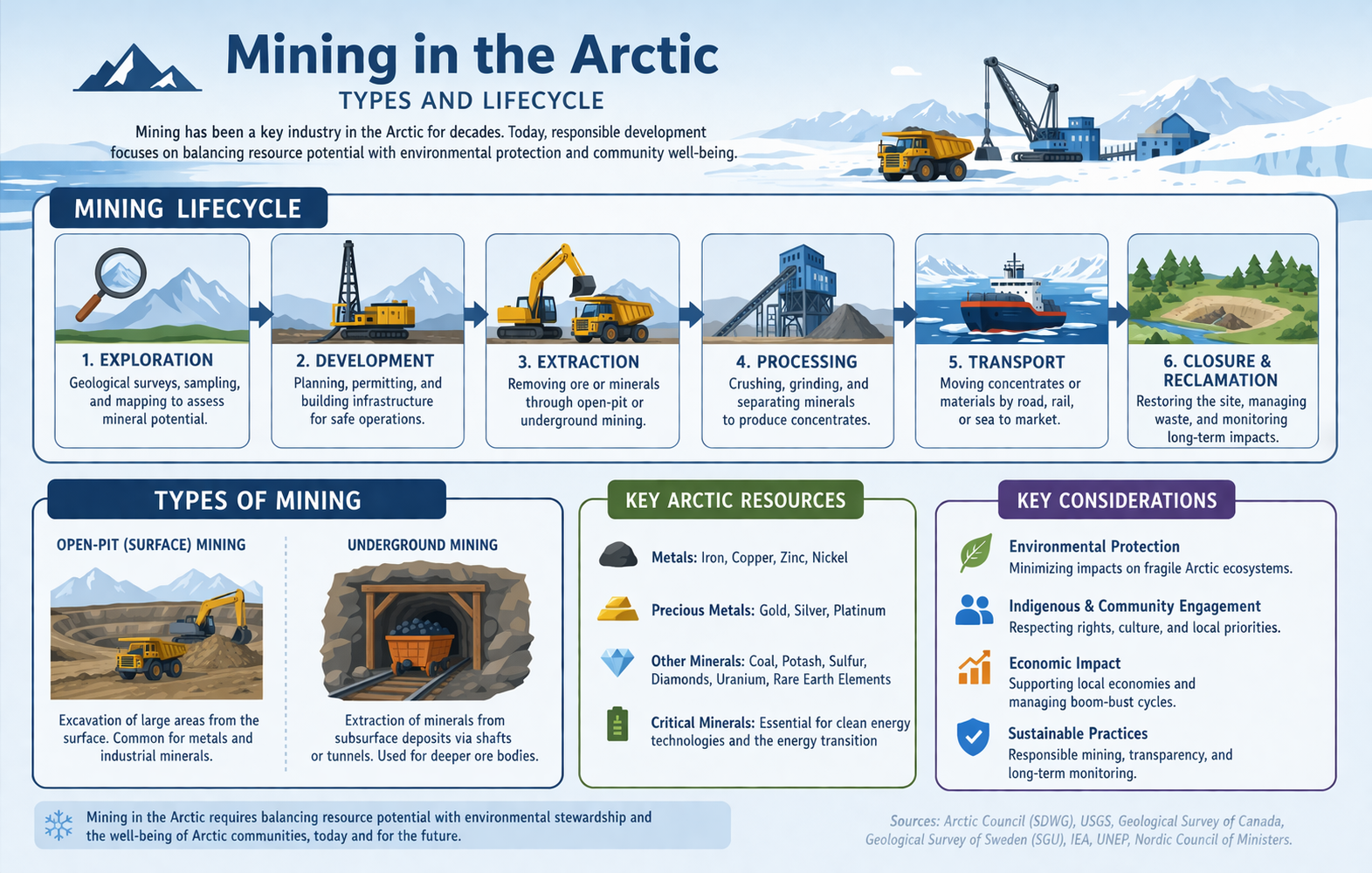
Mining can be broadly defined as the exploration, extraction, processing, and transport of mineral resources for use in industry and manufacturing.
Key Resources
The Arctic is rich in a wide range of mineral resources, including:
- Metals: iron, copper, zinc, nickel
- Precious metals: gold, silver, platinum
- Industrial minerals: coal, sulfur, potash
- Other resources: diamonds, uranium, rare earth elements
Notable examples of Arctic mining include:
- Iron ore in Kiruna (Sweden)
- Coal in Svalbard (Norway)
- Gold in Canada and Russia
- Diamonds in northern Russia and Canada
- Nickel on the Kola Peninsula (Russia)
Mining operations may take place as open-pit (surface) mining or underground mining, depending on the location and type of resource.
Growing Importance of Critical Minerals
In recent years, attention has increasingly focused on the Arctic’s potential for critical minerals—materials essential for renewable energy technologies, batteries, and electronics.
This includes elements such as rare earths, cobalt, and lithium, which are important for the global energy transition. As demand for these materials grows, Arctic regions are becoming more strategically important.
Environmental Impacts
Mining activities can have significant environmental impacts, particularly in the Arctic’s fragile ecosystems. These may include:
- Landscape disturbance and habitat loss
- Pollution, including heavy metals in soil and water
- Long recovery times, due to cold climates and slow ecological processes
Environmental management and monitoring are therefore critical components of modern mining operations in the region.
Social and Economic Effects
Mining has also shaped Arctic communities in important ways. Many settlements have developed around mining activities, sometimes as single-industry towns.
This can create economic opportunities but also challenges. Mining regions often experience “boom and bust” cycles, where local economies are highly dependent on global commodity prices.
In addition, mining activities may affect Indigenous communities, particularly in relation to land use, livelihoods, and cultural practices. Increasingly, there is emphasis on consultation, benefit-sharing, and sustainable development.
Mining in the Arctic Today
Today, Arctic mining is influenced by a combination of:
- global demand for minerals and critical resources
- environmental regulations and sustainability standards
- technological advances in extraction and monitoring
- geopolitical interest in Arctic resources
As with other Arctic industries, there is a growing focus on balancing economic development with environmental protection and social responsibility.
Sources: Geological Survey of Sweden (SGU), International Energy Agency (IEA)