Future Development of Arctic Mining
 Growing Global Demand
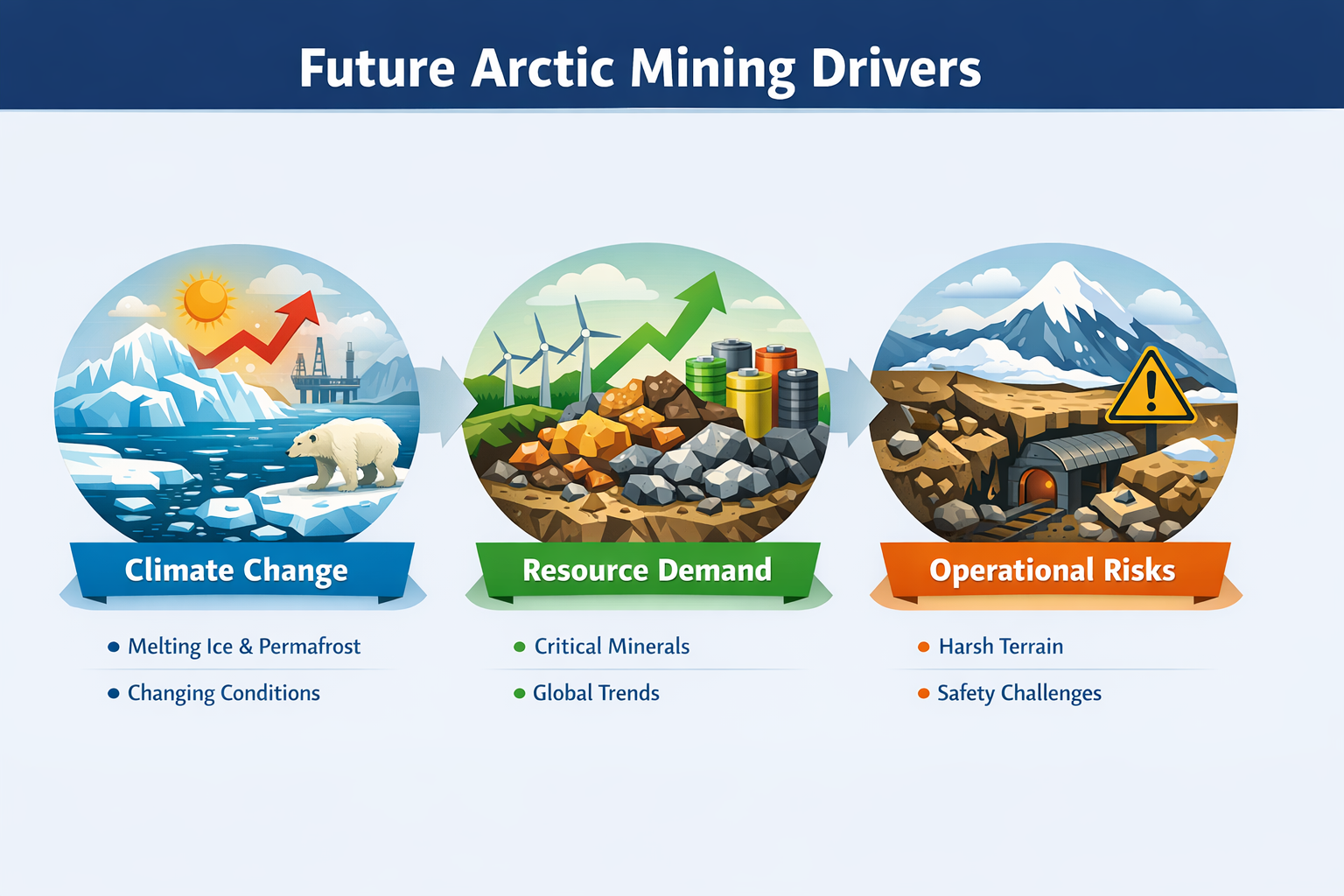
Global demand for minerals is expected to remain strong, particularly for metals and critical minerals such as iron, copper, zinc, rare earth elements, and uranium. These materials are essential for infrastructure, electronics, and the transition to low-carbon energy systems.
As a result, the Arctic, rich in both traditional and critical minerals, continues to attract interest as a potential source of future supply.
Changing Accessibility
Climate change is already influencing Arctic mining conditions. Retreating sea ice and longer ice-free periods are improving access to some remote areas and expanding seasonal shipping opportunities.
At the same time, these changes also introduce new challenges. Thawing permafrost, unstable ground conditions, and changing weather patterns can complicate infrastructure development and increase operational risks.
Infrastructure and Transport
Transport remains a key factor in Arctic mining. While improved marine access and shipping routes may support future development, other systems—such as ice roads and railways, may become less reliable due to warming temperatures.
This creates a complex situation where some forms of access improve, while others become more difficult or costly.
Regional Developments
Several Arctic regions are actively exploring or expanding mining activities:
- Greenland has seen increased interest in minerals such as rare earth elements, zinc, and iron ore
- Canada continues to develop mining projects in northern territories
- Russia remains a major producer, particularly of nickel, coal, and other minerals
However, many proposed projects remain uncertain and depend on market conditions, regulation, and local acceptance.
Environmental and Social Considerations
Future mining development in the Arctic will be shaped by stricter expectations around:
- environmental protection and monitoring
- Indigenous rights and community engagement
- sustainable land use and long-term impacts
These factors are increasingly central to decision-making and project approval processes.
Economic Uncertainty
Although mineral demand is growing, Arctic mining projects remain high-cost and long-term investments. Their viability depends on:
- global commodity prices
- infrastructure availability
- regulatory frameworks
- technological advances
This means that development is likely to be selective rather than widespread, with some projects moving forward while others are delayed or cancelled.
Looking Ahead
The future of Arctic mining is shaped by a combination of resource demand, climate change, economic conditions, and environmental priorities.
While opportunities for development exist, they must be balanced with the need for sustainable practices, economic diversification, and protection of Arctic ecosystems and communities.
Sources: International Energy Agency (IEA), Nordic Council of Ministers, OECD