
Oil Extraction
 Overview
Oil extraction refers to the process of locating, drilling, and producing hydrocarbons (petroleum) from underground reservoirs. Modern extraction combines advanced geophysical methods, engineering technologies, and reservoir management techniques to efficiently recover oil and gas resources.
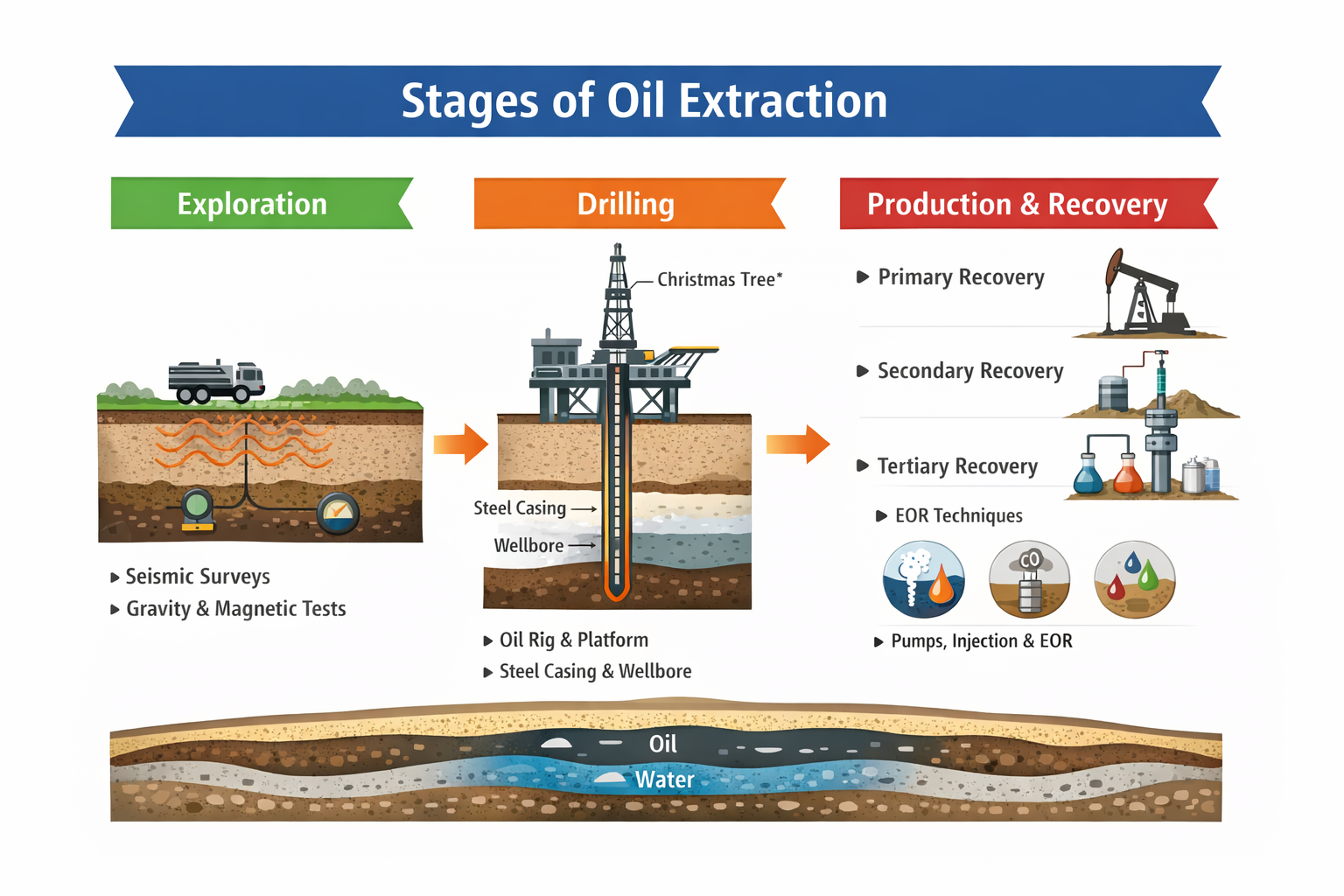
The process is generally divided into three main stages: exploration, drilling, and production (recovery).
Exploration: Finding oil and gas
Before extraction can begin, potential oil and gas reservoirs must be identified. This is done using a range of geophysical techniques, most notably seismic surveys, which map subsurface structures by analysing how sound waves travel through the Earth.
Additional tools such as gravity and magnetic surveys may also be used to detect variations in subsurface geology that could indicate the presence of hydrocarbons.
Drilling: Accessing the reservoir
Once a suitable location is identified, a well is drilled into the subsurface using an oil rig. On land, rigs are mobile structures, while offshore drilling takes place from fixed or floating platforms.
The drilled well is lined with steel casing and cement to stabilise the borehole and prevent contamination of the surrounding layers. At the target depth, the casing is perforated to allow oil and gas to flow into the well.
At the surface, a system of valves and controls, commonly known as a “Christmas tree”, is installed to regulate pressure and control the flow of hydrocarbons.
Production and recovery
After drilling, oil is brought to the surface through a series of recovery methods. These are typically grouped into three stages:
Primary recovery
In the early phase, oil is produced using the natural pressure of the reservoir. Gas expansion and natural water pressure can drive oil toward the wellbore, allowing it to flow to the surface with minimal intervention.
Secondary recovery
As reservoir pressure declines, additional methods are used to maintain production. This often involves injecting water or gas into the reservoir to increase pressure and push remaining oil toward the well.
Mechanical systems such as pumps may also be used to assist extraction.
Tertiary recovery (Enhanced Oil Recovery – EOR)
When primary and secondary methods are no longer sufficient, enhanced oil recovery (EOR) techniques are applied to extract additional oil.
These include:
- Thermal methods, such as steam injection, to reduce oil viscosity
- Gas injection, including CO₂, to improve flow
- Chemical injection, to reduce surface tension and improve mobility
In some cases, microbial methods are explored, where microorganisms help break down hydrocarbons into more fluid components.
While EOR can significantly increase recovery rates, it requires additional energy and resources, making it more complex and costly.
Oil extraction today
Modern oil extraction increasingly relies on advanced technologies, including horizontal drilling, digital monitoring, and automation, to improve efficiency and reduce environmental impact.
At the same time, oil production is increasingly evaluated in the context of climate change, environmental protection, and the global energy transition, particularly in sensitive regions such as the Arctic.
Sources: Britannica, Petroleum