Future Development of Renewable Energy in the Arctic
 The Transition to a Green Economy
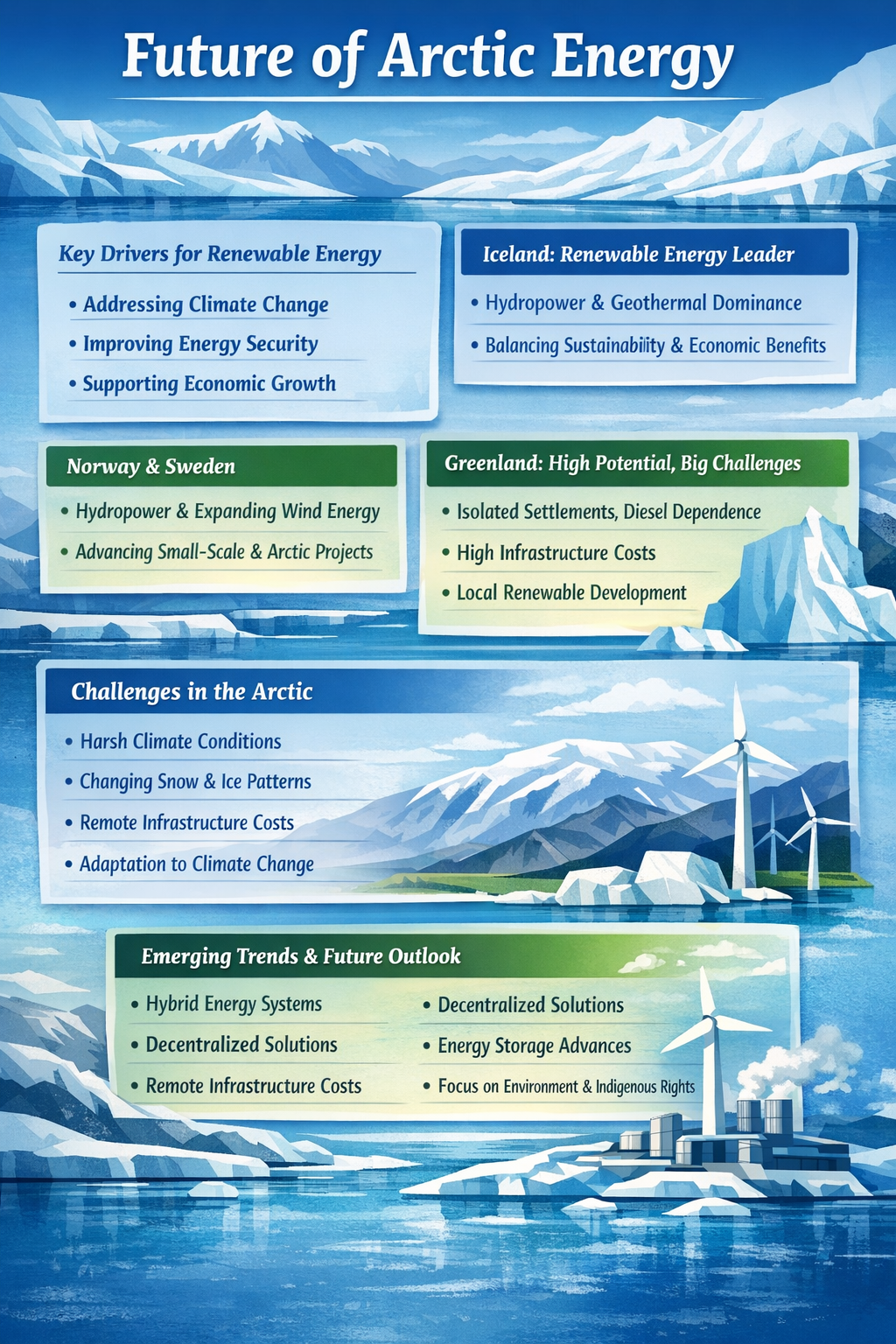
Efforts to transition toward a “green economy” have become a central priority for governments, industries, and communities across the circumpolar North. While the future of renewable energy in the Arctic remains complex and uncertain, it is increasingly shaped by three key drivers:
- The need to address climate change and environmental degradation
- The goal of improving energy security and reducing dependence on imported fossil fuels
- The ambition to support economic development and job creation in remote and rural regions
Balancing these priorities remains a challenge, particularly as renewable energy projects must be both economically viable and environmentally sustainable.
Iceland: Renewable Energy Leadership
Iceland continues to serve as a global leader in renewable energy development. Its energy system is largely based on hydropower and geothermal energy, which together provide nearly all electricity and heating needs.
In recent years, Iceland has placed greater emphasis on:
- Sustainable resource management
- National economic benefits from energy production
- Diversification beyond energy-intensive industries such as aluminum
While renewable energy remains a cornerstone of Iceland’s economy, there is growing debate about how energy resources should be used and who benefits from them.
Norway and Sweden: Expanding Renewable Portfolios
Norway and Sweden are also advancing renewable energy systems, though with different approaches:
- Norway relies heavily on hydropower but is increasingly investing in wind energy, including Arctic and offshore projects
- Sweden has diversified its energy mix, combining hydropower, wind, and other renewables
Technological improvements have made wind energy more viable in harsh Arctic conditions, including turbines designed to withstand cold temperatures and ice formation. Both countries are also investing in small-scale and decentralized energy systems.
Greenland: High Potential, Structural Challenges
Greenland has significant renewable energy potential, particularly in hydropower, due to its vast ice sheet and water resources. However, its energy system remains largely dependent on diesel generators.
Key challenges include:
- Isolated settlements with no interconnected grid
- High infrastructure costs for building transmission networks
- Geographic and climatic constraints
Future development is likely to focus on:
- Expanding local renewable energy production
- Improving energy efficiency
- Exploring opportunities to export energy indirectly through energy-intensive industries
Technological and Environmental Challenges
The Arctic presents unique challenges for renewable energy development:
- Extreme cold, frost, and ice affecting infrastructure
- Changing precipitation and snowmelt patterns due to climate change
- Impacts on hydropower reliability and water availability
- High costs of construction and maintenance in remote regions
Adapting energy systems to climate change is becoming increasingly important, particularly for hydropower, which depends on stable water cycles.
Emerging Trends and Future Outlook
Recent developments suggest several key trends shaping the future of renewable energy in the Arctic:
- Increased use of hybrid energy systems (e.g. wind + solar + storage)
- Growth of decentralized and community-based energy solutions
- Advances in energy storage technologies
- Greater focus on environmental protection and Indigenous rights
- Exploration of new technologies such as hydrogen and advanced geothermal systems
Overall, the future of renewable energy in the Arctic will depend on balancing economic development, environmental sustainability, and social responsibility.
Sources:Arctic Climate Impact Assessment, Sustainable Planning of Megaprojects in the North