
Nuclear Accidents
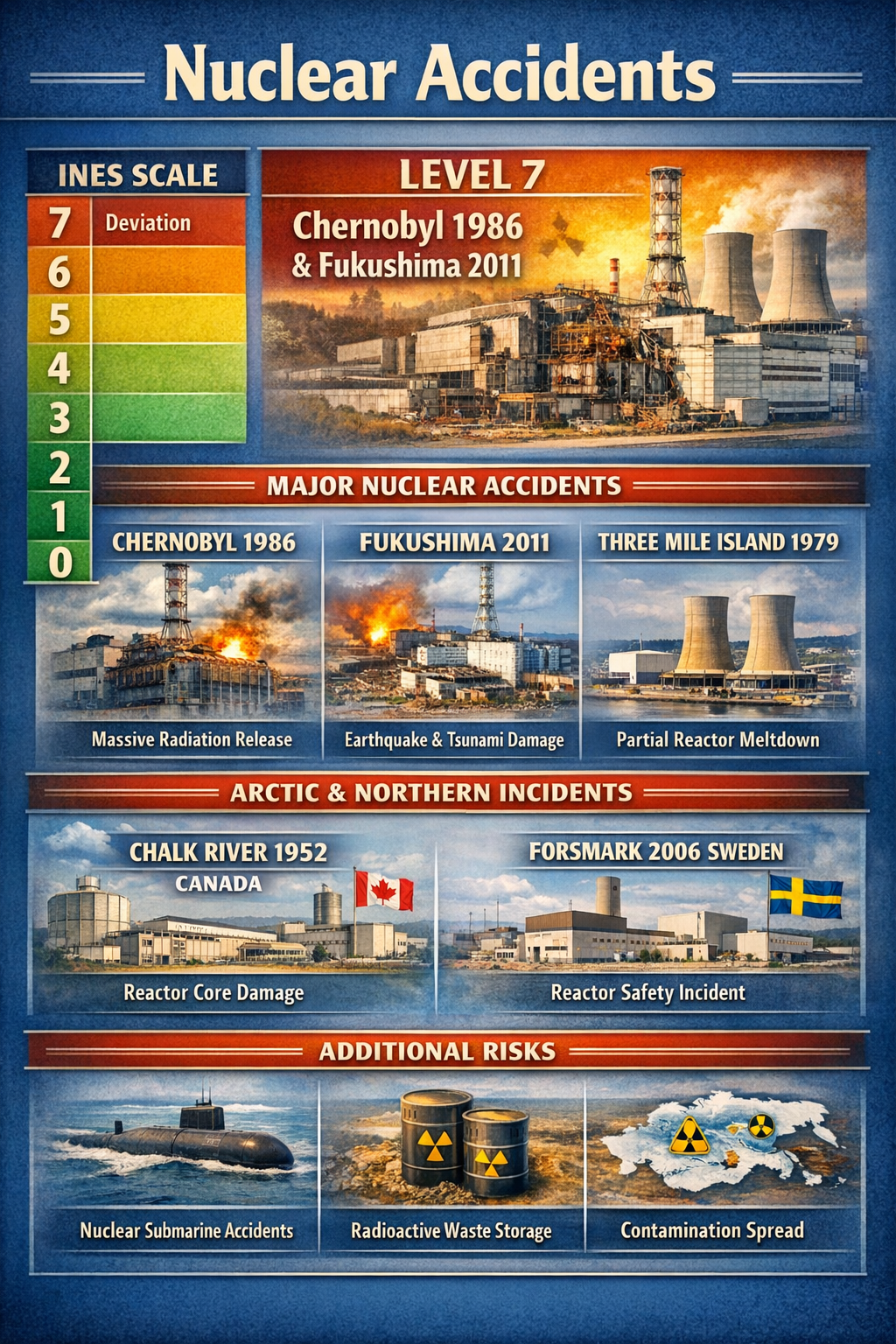 The use of nuclear energy offers significant benefits, but it also carries risks. Major nuclear accidents such as Chernobyl (1986), Fukushima Daiichi (2011), and Three Mile Island (1979) highlight the potential consequences of reactor failures. These events have shaped global perceptions of nuclear safety and influenced energy policy worldwide.
The INES Scale
To improve communication and classification of nuclear incidents, the International Atomic Energy Agency (IAEA) introduced the International Nuclear and Radiological Event Scale (INES) in 1990.
- The scale ranges from Level 0 (deviation) to Level 7 (major accident)
- It helps governments and the public understand the severity of nuclear events
So far, only two accidents have reached Level 7:
- Chernobyl, Ukraine (1986)
- Fukushima Daiichi, Japan (2011)
Major Nuclear Accidents
Chernobyl (1986)
- Reactor explosion and fire in Ukraine (former Soviet Union)
- Widespread radioactive contamination across Europe
- Long-term environmental and health impacts
- Effects were detected even in parts of the Arctic
Fukushima Daiichi (2011)
- Caused by a tsunami following a major earthquake in Japan
- Reactor meltdowns and radioactive release
- Large-scale evacuation and long-term cleanup
Three Mile Island (1979)
- Partial reactor meltdown in the United States
- Limited radiation release
- No direct fatalities, but major impact on public trust in nuclear energy
Nuclear Incidents in the Arctic and Northern Regions
While large-scale nuclear disasters have not occurred directly within the Arctic, several incidents have taken place in northern regions:
Chalk River (Canada, 1952)
- Early reactor accident in Ontario
- Core damage due to technical failure and human error
- No long-term environmental or health impacts reported
- Not formally rated on INES (occurred before the scale existed)
Forsmark (Sweden, 2006)
- Electrical fault caused shutdown of a reactor
- Classified as INES Level 2 (incident)
- No radiation release or injuries
Other Arctic-Relevant Concerns
- Accidents involving nuclear submarines and vessels in Arctic waters
- Storage and disposal of radioactive materials in northern regions
- Long-range transport of radioactive particles from major accidents
Risks and Lessons Learned
Nuclear accidents have highlighted key risks:
- Human and technical errors
- Natural disasters impacting infrastructure
- Long-term environmental contamination
- Challenges in emergency response and evacuation
However, they have also led to:
- Improved safety standards
- Stronger international regulations
- Advances in reactor design and monitoring systems
Current Perspective
Modern nuclear technology is significantly safer than earlier designs, with multiple safety systems in place. However, nuclear accidents remain a central concern in debates about the future of nuclear energy, particularly in environmentally sensitive regions such as the Arctic.
Sources:IAEA 2, IAEA 3, World Nuclear Association