

Sunken Nuclear Submarines
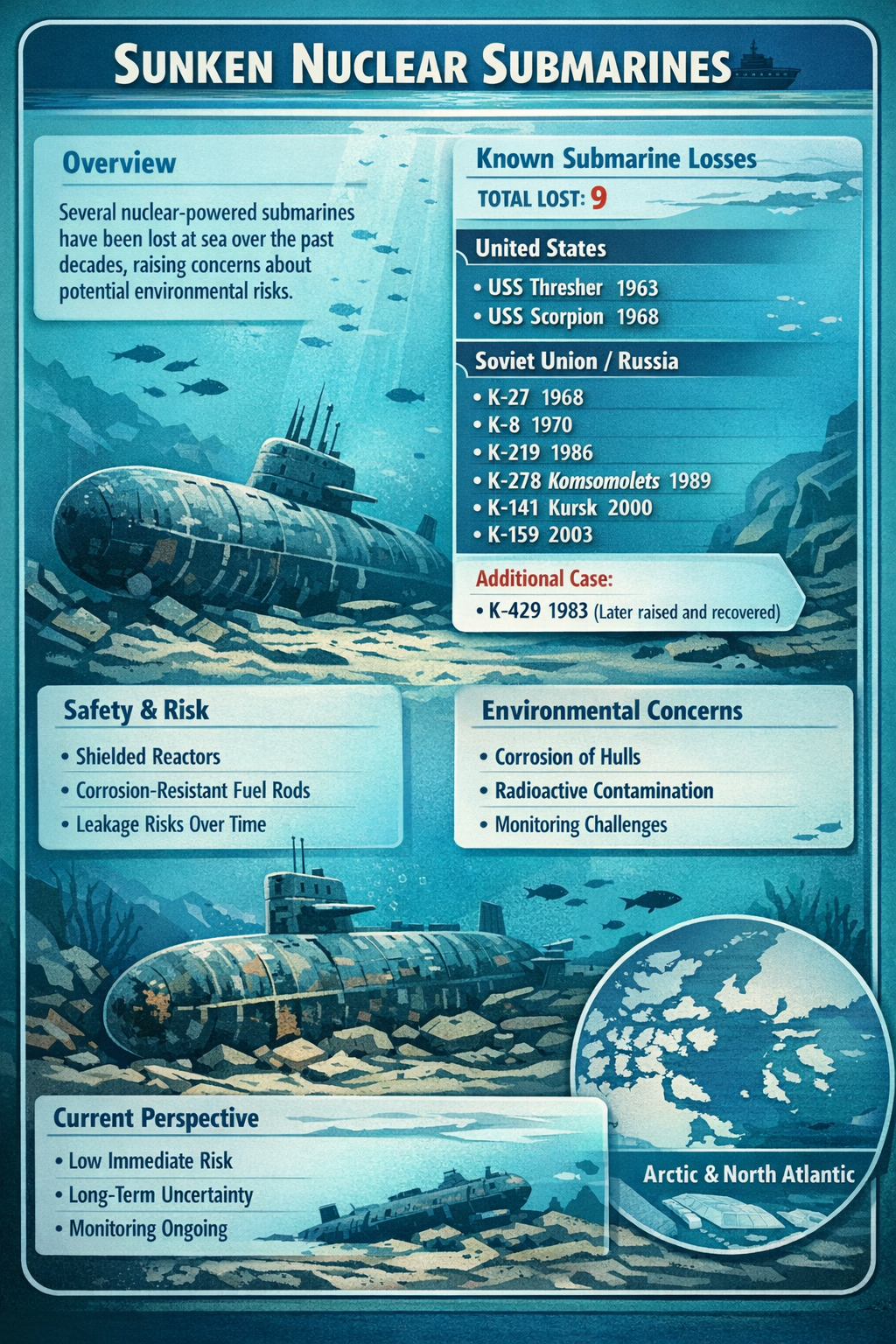
Several nuclear-powered submarines have been lost at sea over the past decades, mainly during the Cold War. These incidents have raised concerns about potential environmental risks, particularly in the Arctic and North Atlantic regions where many wrecks are located.
Known Submarine Losses
A total of nine nuclear-powered submarines are known to have sunk:
United States
- USS Thresher (1963)
- USS Scorpion (1968)
Soviet Union
- K-8 (1970)
- K-27 (1968)
- K-219 (1986)
- K-278 Komsomolets (1989)
Russian Federation
- K-141 Kursk (2000)
- K-159 (2003)
Additional Case
- K-429 (1983) – sank but was later raised and returned to service, which is why it is sometimes excluded from earlier counts
Most of these submarines rest at significant ocean depths, particularly in the Barents Sea and North Atlantic.
Safety Features and Risk of Leakage
Nuclear reactors in submarines are designed with multiple safety barriers:
- Fuel rods are sealed in corrosion-resistant materials
- Reactor compartments are heavily shielded
- Systems are designed to limit exposure to seawater
These features significantly reduce the likelihood of immediate radiation leakage.
Environmental Concerns
Despite safety measures, long-term risks remain:
- Corrosion of submarine hulls over time
- Potential release of radioactive materials into marine environments
- Presence of nuclear weapons or fuel in some wrecks
- Difficulty in monitoring deep-sea wreck sites
Some submarines, such as K-27 and K-159, are considered higher risk due to their condition and disposal methods.
Current Scientific Perspective
Current research suggests that:
- Most wrecks currently pose low immediate risk
- However, long-term environmental uncertainty remains, especially as corrosion progresses
- Monitoring and international cooperation are essential to assess future risks
Countries such as Norway and Russia continue to monitor sites like K-278 (Komsomolets) for potential radiation leakage
Future Challenges
Key challenges include:
- Long-term monitoring of submerged reactors
- Managing potential environmental impacts in sensitive Arctic ecosystems
- Developing safe strategies for containment or recovery (if needed)
As Arctic environments are particularly fragile, even small releases could have significant ecological consequences.
Source: Norwegian Radiation and Nuclear Safety Authority (DSA), International Atomic Energy Agency (IAEA)