

Case study: Tumbler Ridge
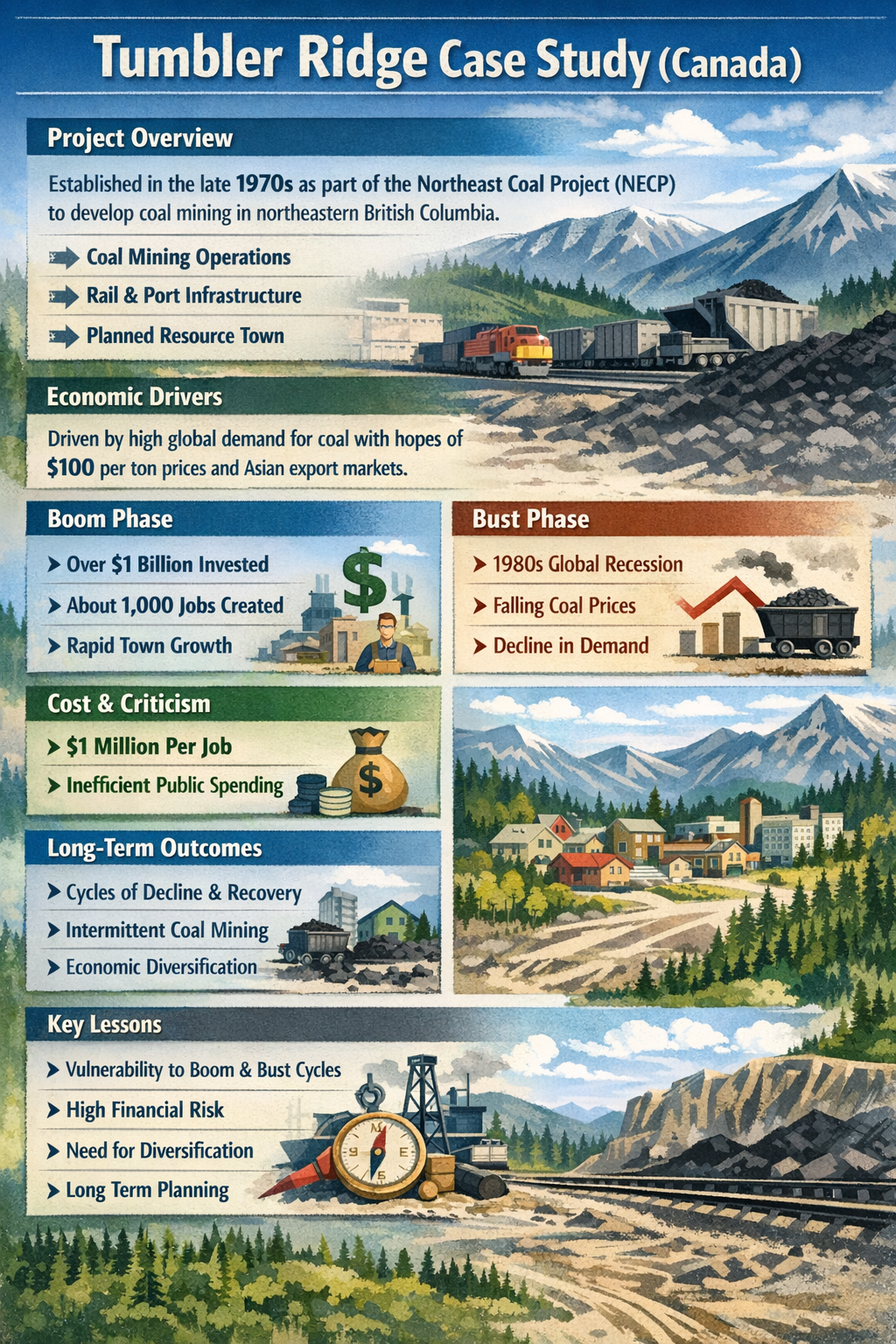 Tumbler Ridge, located in northeastern British Columbia, Canada, is a classic example of a single-industry town developed as part of a large-scale resource megaproject.
The town was established in the late 1970s under the Northeast Coal Project (NECP), driven by strong international demand for coal, particularly from Japan’s steel industry.
The project included:
- Development of large-scale coal mining operations
- Construction of transport infrastructure (railways and ports)
- Creation of an entirely new planned town (Tumbler Ridge)
Economic Drivers
The project was based on expectations of:
- Continued high global demand for coal
- Rising coal prices (projected up to $100 per ton)
- Long-term export opportunities to Asian markets
Governments invested heavily, viewing the project as a way to stimulate regional development and employment.
Boom Phase: Rapid Development
During the early phase, the project brought:
- Significant public investment (over $1 billion)
- Creation of approximately 1,000 jobs
- Rapid construction of infrastructure and housing
- Growth of a new, modern community
Tumbler Ridge was designed as a planned industrial town, heavily dependent on coal mining.
Bust Phase: Economic Decline
By the early 1980s, global economic conditions shifted:
- Recession reduced demand for steel
- Coal prices declined sharply
- Export markets weakened
As a result, the economic foundation of the project weakened, leading to reduced activity and instability in the region.
Economic Efficiency and Criticism
The project faced criticism for its high cost:
- Over $1 billion in public investment
- Approximately $1 million per job created
Critics argued that the project represented an inefficient use of public funds and highlighted the risks of large-scale, resource-dependent development strategies.
Long-Term Outcomes
Although the original project struggled, Tumbler Ridge did not completely disappear:
- The town experienced cycles of decline and recovery
- Coal mining has continued intermittently under changing market conditions
- The community has attempted to diversify its economy (e.g. tourism, geopark status)
This reflects the resilience of some resource-based communities, even after major economic shocks.
Key Lessons
The Tumbler Ridge case highlights important lessons for Arctic and northern development:
- Strong dependence on global markets creates vulnerability
- Resource-based megaprojects are exposed to boom–bust cycles
- Large public investments carry significant financial risk
- Economic diversification is critical for long-term sustainability
- Planning must consider long-term market uncertainty
Relevance to the Arctic
Although located in sub-Arctic Canada, Tumbler Ridge reflects broader patterns seen across the circumpolar North:
- Development of single-industry communities
- Heavy reliance on external demand and investment
- Exposure to global commodity price fluctuations
- Challenges in maintaining long-term economic stability
Current Perspective
Today, Tumbler Ridge is often used as a case study in resource-dependent development, illustrating both:
- The potential benefits of megaproject-driven growth
- The risks associated with economic dependency and market volatility
Source: Government of British Columbia, Natural Resources Canada