
Oil in the Arctic
 What Is Crude Oil?
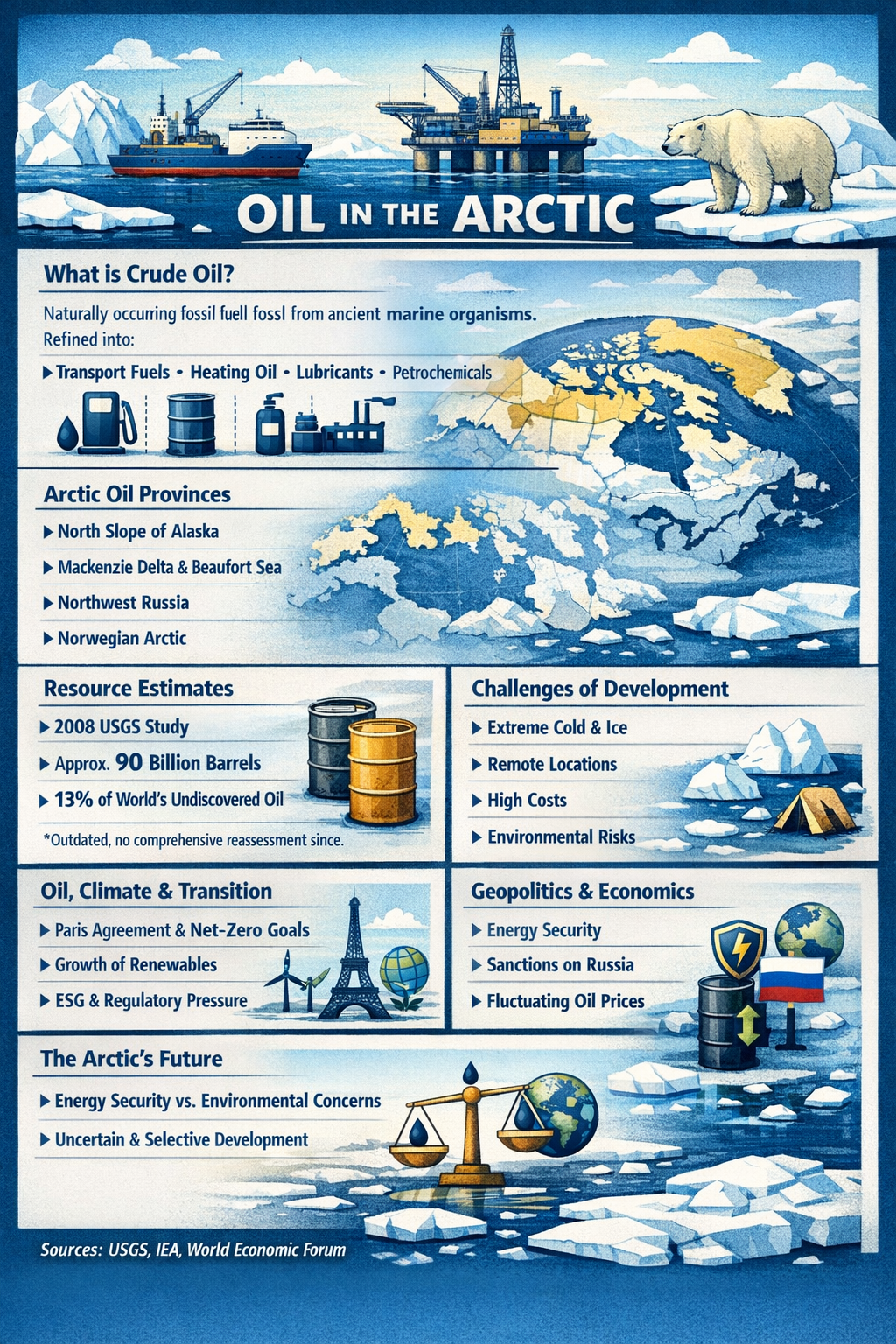
Crude oil is a naturally occurring liquid fossil fuel formed over millions of years from the remains of ancient marine organisms buried beneath sediment and rock. Under heat and pressure, this organic material transformed into hydrocarbons, compounds composed primarily of hydrogen and carbon.
Crude oil is refined into products such as:
- Transport fuels (petrol, diesel, aviation fuel)
- Heating oil
- Lubricants
- Petrochemical feedstocks used in plastics, synthetic materials, and industrial products
Petroleum geology is the scientific discipline focused on locating and assessing subsurface oil deposits.
Arctic Oil Provinces
Significant oil-bearing regions in the Arctic include:
- The North Slope of Alaska (including the Prudhoe Bay area)
- The Mackenzie Delta and Beaufort Sea (Canada)
- Parts of the Canadian Arctic Archipelago
- Northwest Russia, including offshore areas of the Barents and Kara Seas
- The Norwegian Arctic, particularly the Barents Sea
Oil production is currently established in parts of Alaska, Norway, and Russia, while other areas remain under exploration or are undeveloped.
Resource Estimates
In 2008, the U.S. Geological Survey (USGS) assessed undiscovered, technically recoverable oil resources north of the Arctic Circle (No updated circumpolar reassessment has replaced this study).
The study estimated approximately 90 billion barrels of undiscovered oil in the Arctic. This represents about 13% of the world’s undiscovered oil resources.
It is important to note that:
- These figures refer to technically recoverable oil, not proven reserves.
- Economic viability depends on oil prices, infrastructure, and regulatory conditions.
- Environmental and climate policies may limit future development.
Most of the estimated oil resources are believed to be located offshore.
Challenges of Arctic Oil Development
Oil exploration and production in the Arctic remain technically and environmentally challenging:
- Extreme cold, ice cover, and harsh weather
- Long periods of darkness and seasonal accessibility
- Remote locations with limited infrastructure
- High operational and transportation costs
- Sensitive ecosystems with slow recovery rates
- Indigenous land-use and subsistence considerations
Oil spill response in icy waters remains particularly difficult, and is a major concern in Arctic offshore development.
Oil, Climate, and the Future
Since the 2010s, Arctic oil development has increasingly been shaped by global climate policy and the energy transition:
- The Paris Agreement (2015) and net-zero targets
- Growing investment in renewable energy
- Pressure from ESG (Environmental, Social, Governance) standards
- Increasing scrutiny from governments, investors, and the public
As a result, some Arctic projects have been delayed, scaled back, or cancelled, while others continue where economic or strategic interests remain strong.
Geopolitics and Economic Factors
Arctic oil development is also influenced by geopolitical and economic dynamics:
- Energy security concerns, particularly in Europe and Asia
- Fluctuating global oil prices
- Sanctions and international relations (especially affecting Russian Arctic projects)
- Strategic interest in Arctic shipping routes and resources
These factors can accelerate or slow development depending on global conditions.
The Arctic in the Global Oil Debate
Arctic oil development sits at the intersection of several competing priorities:
- Energy security
- Economic development
- Environmental protection
- Indigenous rights
- Climate responsibility
The future of Arctic oil will depend on how these factors are balanced in a rapidly changing global energy system.
Future Outlook
The long-term role of Arctic oil remains uncertain. Key trends include:
- Continued but selective development in economically viable regions
- Increasing regulatory and environmental constraints
- Greater competition from renewable energy sources
- Technological advances improving efficiency and safety
While Arctic oil resources remain significant, their development will likely be more limited and carefully managed than previously expected.
Sources:US Geological Survey