Indigenous People of the Arctic - Enets
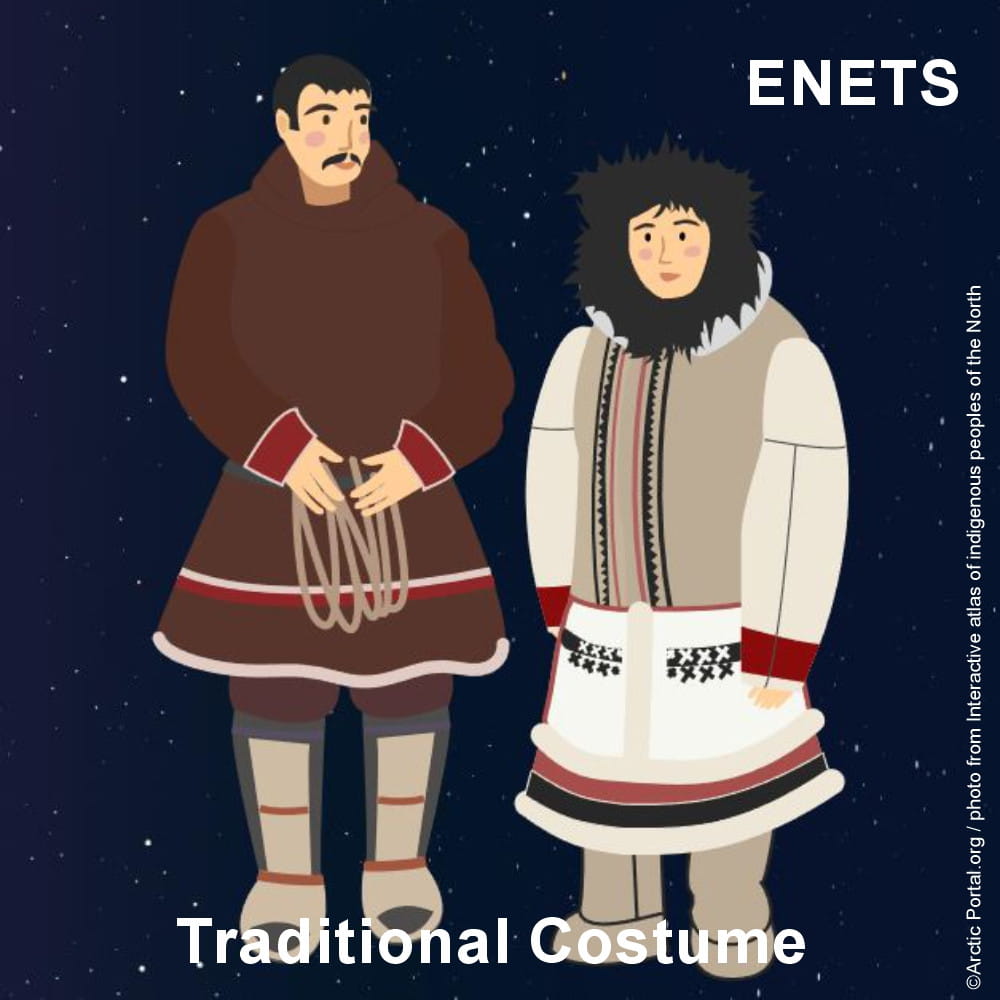


The Enets are one of the smallest Indigenous peoples of the Russian North. They live in the Krasnoyarsk Territory, mainly along the lower eastern bank of the Yenisei River in the Taimyr Dolgano-Nenets District.
Traditionally, the Enets were nomadic, moving across the tundra and forest-tundra. They developed into two main groups:
- Tundra Enets (somatu): reindeer herders who migrated seasonally across the tundra between the Yenisei and Pur rivers, moving south in winter.
- Forest Enets (pya bai): lived further south in the forest zone near present-day Dudinka.
The two groups differed in dialect and aspects of traditional culture.
According to the 2020 All-Russian Population Census, the total Enets population is 203 people, with 102 men and 101 women.
People & Language
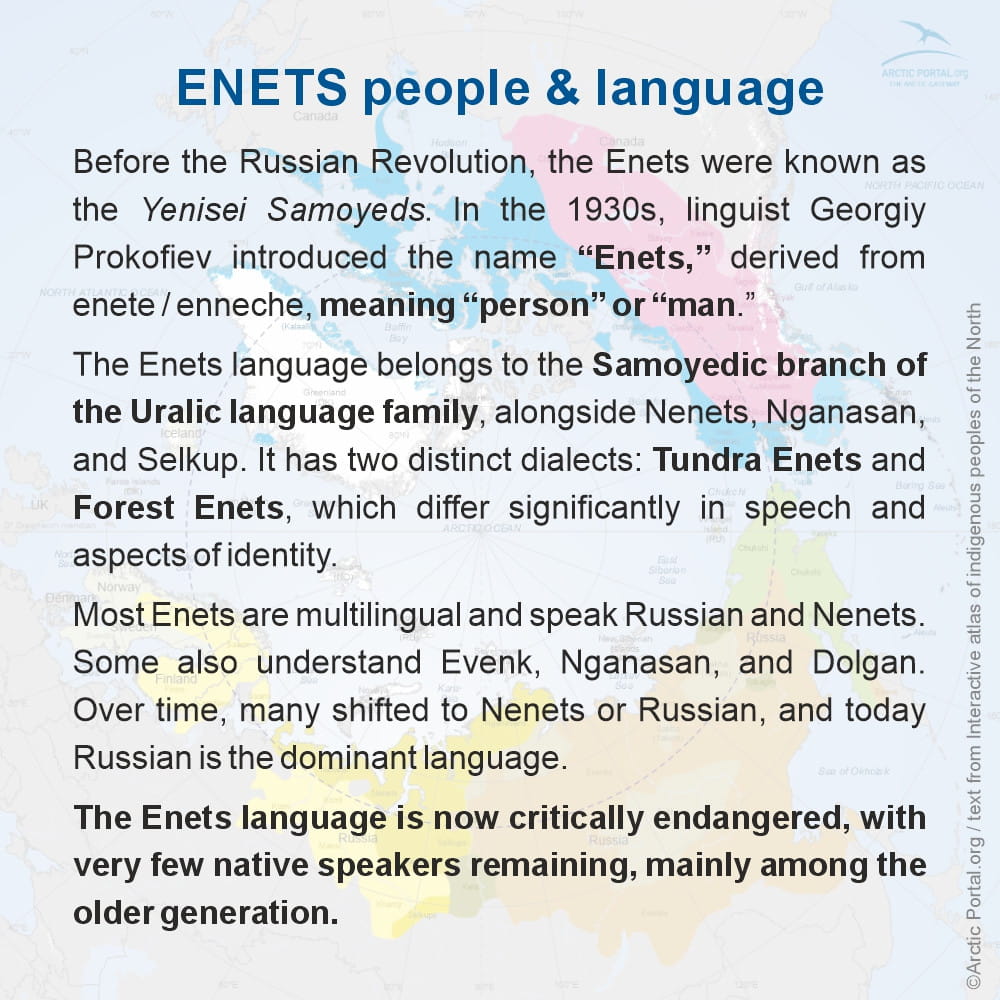
Before the Russian Revolution, the Enets were known as the Yenisei Samoyeds. In the 1930s, linguist Georgiy Prokofiev introduced the name “Enets,” derived from enete / enneche, meaning “person” or “man.”
The Enets language belongs to the Samoyedic branch of the Uralic language family, alongside Nenets, Nganasan, and Selkup. It has two distinct dialects: Tundra Enets and Forest Enets, which differ significantly in speech and aspects of identity.
Most Enets are multilingual and speak Russian and Nenets. Some also understand Evenk, Nganasan, and Dolgan. Over time, many shifted to Nenets or Russian, and today Russian is the dominant language.
The Enets language is now critically endangered, with very few native speakers remaining, mainly among the older generation.
People & Culture
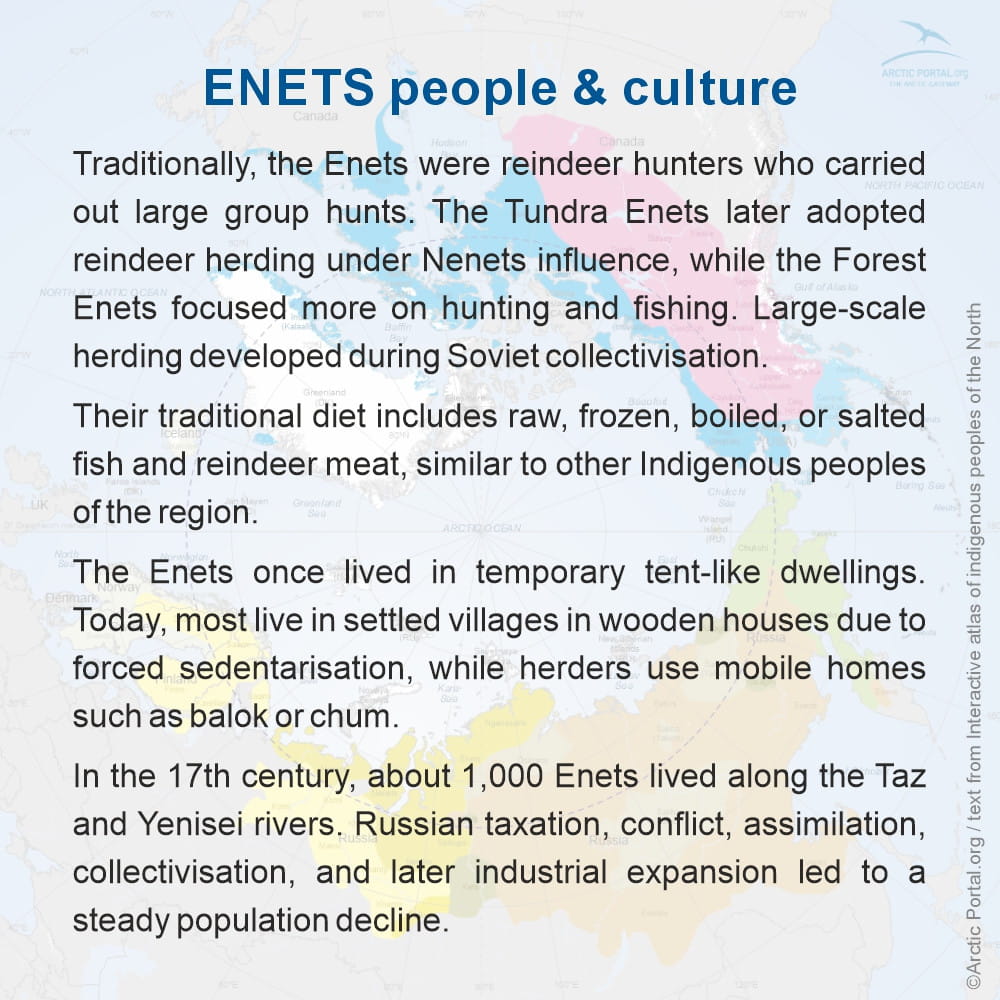
Traditionally, the Enets were reindeer hunters who carried out large group hunts. The Tundra Enets later adopted reindeer herding under Nenets influence, while the Forest Enets focused more on hunting and fishing. Large-scale herding developed during Soviet collectivisation.
Their traditional diet includes raw, frozen, boiled, or salted fish and reindeer meat, similar to other Indigenous peoples of the region.
The Enets once lived in temporary tent-like dwellings. Today, most live in settled villages in wooden houses due to forced sedentarisation, while herders use mobile homes such as balok or chum.
In the 17th century, about 1,000 Enets lived along the Taz and Yenisei rivers. Russian taxation, conflict, assimilation, collectivisation, and later industrial expansion led to a steady population decline.
Spiritual Culture of the Evens
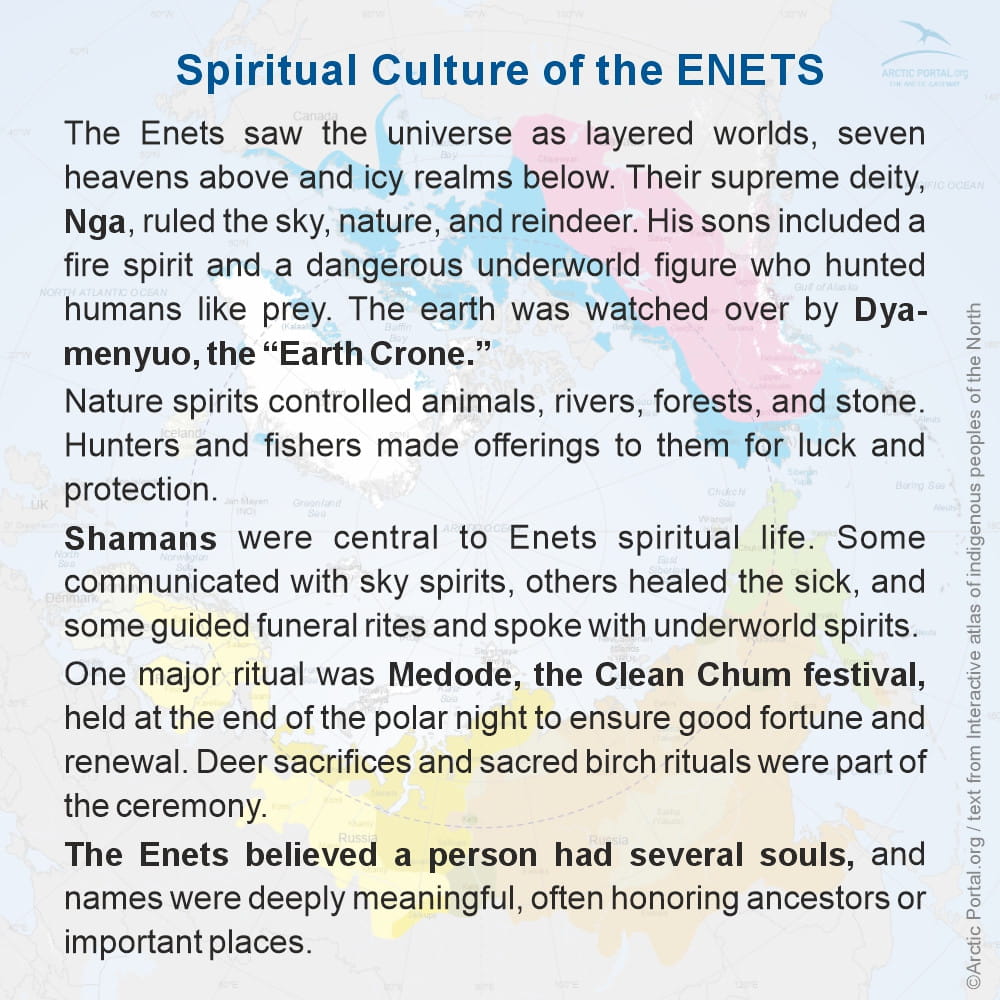
The Enets saw the universe as layered worlds, seven heavens above and icy realms below. Their supreme deity, Nga, ruled the sky, nature, and reindeer. His sons included a fire spirit and a dangerous underworld figure who hunted humans like prey. The earth was watched over by Dya-menyuo, the “Earth Crone.”
Nature spirits controlled animals, rivers, forests, and stone. Hunters and fishers made offerings to them for luck and protection.
Shamans were central to Enets spiritual life. Some communicated with sky spirits, others healed the sick, and some guided funeral rites and spoke with underworld spirits.
One major ritual was Medode, the Clean Chum festival, held at the end of the polar night to ensure good fortune and renewal. Deer sacrifices and sacred birch rituals were part of the ceremony.
The Enets believed a person had several souls, and names were deeply meaningful, often honoring ancestors or important places.
Source: Interactive atlas of indigenous peoples of the North, Siberia and the Far East
Visit our Map Gallery Arctic Portal specializes in creating customized graphical maps that cover a range of significant Arctic topics with global recognition. We are continuously working on new maps and adding them to our Gallery.